
Your laptop won’t connect to Wi-Fi five minutes before an important meeting.
Your password has suddenly stopped working.
That software update you clicked “remind me later” on has finally caught up.
When IT problems strike, who would you prefer to help you: an AI-powered assistant available instantly, or a real human being at the service desk?
For some people, the answer is simple. If AI can resolve the issue in seconds, why wait for a technician?
Others would rather speak to a person who can understand the problem, ask the right questions, and reassure them when things don’t go as planned.
As Artificial Intelligence becomes increasingly embedded into business operations, this debate is becoming more relevant than ever. The rise of the AI service desk is changing the way organisations deliver IT support, automating routine requests and providing employees with instant access to help.
But does this mean first-line support analysts are becoming obsolete?
Or is the future of IT support actually a partnership between AI and humans?
Let’s explore.
What Is an AI Service Desk?
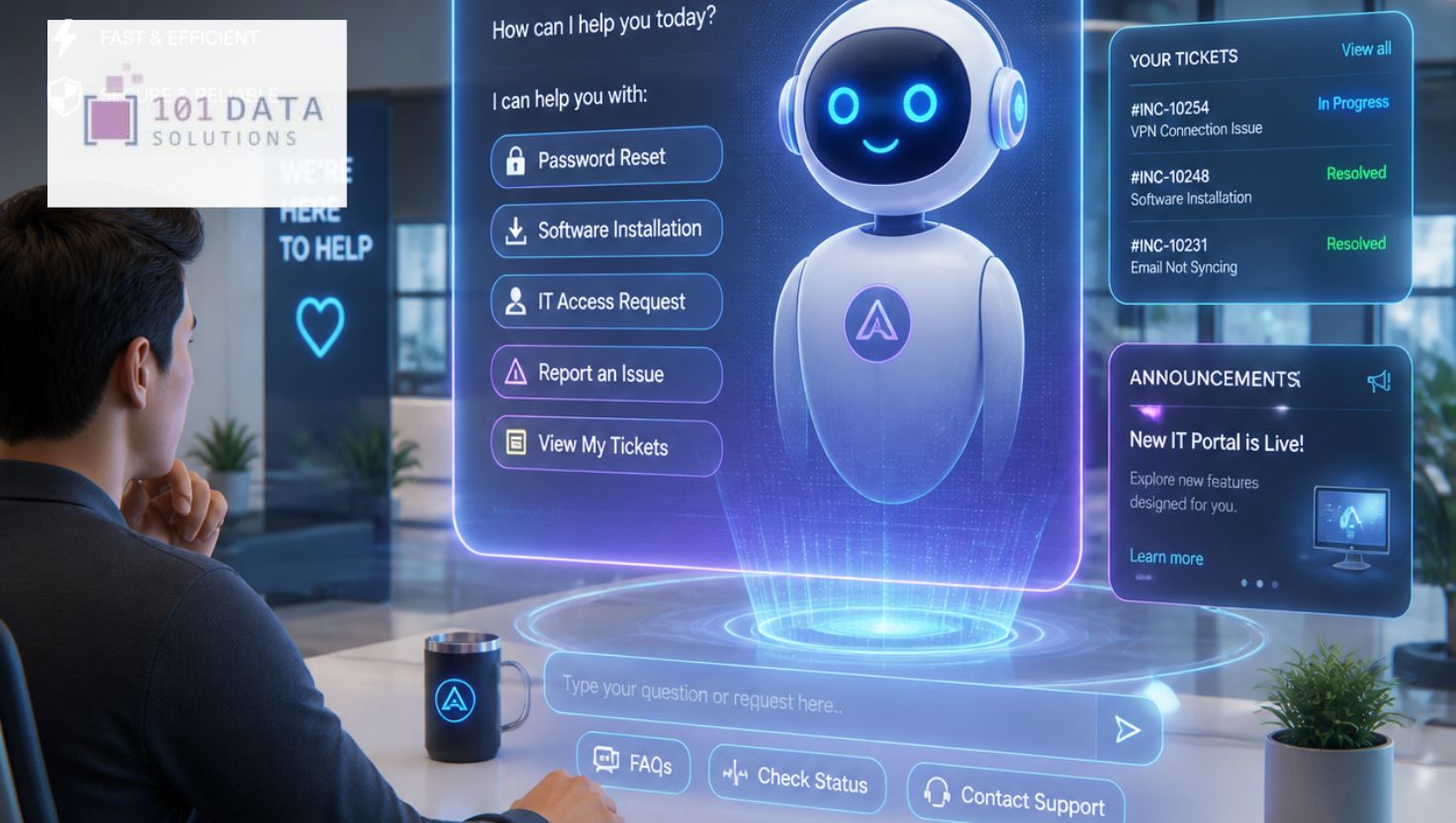
An AI service desk combines artificial intelligence, automation, and IT service management processes to provide faster and more efficient support for employees.
Rather than relying entirely on human technicians, AI can assist by:
- Answering common IT questions
- Resolving routine support requests
- Categorising and prioritising tickets
- Guiding users through troubleshooting steps
- Automating repetitive admin tasks
- Providing 24/7 support through chatbots and virtual assistants
Think of it as having a highly knowledgeable IT assistant that’s always awake, never takes a coffee break, and can handle hundreds of requests at the same time.
Sounds impressive, right?
Well, yes… and no.
The Rise of the AI Service Desk
The modern workplace expects instant answers. Employees don’t want to wait hours for a password reset or spend half their day trying to find the right contact for a simple IT request.
That’s one reason why the AI service desk has gained so much attention.
Today’s AI-powered tools can understand natural language, search knowledge bases, automate workflows, and even resolve common support requests without human intervention. Whether it’s unlocking an account, troubleshooting a VPN issue, or answering a frequently asked question, AI can often deliver a solution in seconds.
For busy IT teams, it’s an attractive proposition. Less time spent on repetitive tasks means more time available for strategic projects and complex support issues.
Why AI Is So Good at First-Line Support
Let’s be honest, many service desk requests are remarkably similar.
Every day, IT teams handle forgotten passwords, access requests, device setup questions, and software installation queries. These issues follow predictable patterns, making them ideal candidates for automation.
Unlike humans, AI doesn’t get tired, need a lunch break, or have a queue of other priorities competing for attention. It can process hundreds of requests simultaneously and deliver a consistent response every time.
For organisations struggling with growing ticket volumes, that’s a game changer.
The Problem AI Still Can't Solve
But here’s where things get interesting.
Technology problems aren’t always technical problems.
Sometimes an employee is stressed because they have a presentation starting in ten minutes. Sometimes the issue they’re describing isn’t actually the issue causing the problem. Sometimes they simply need someone to reassure them that everything will be okay.
That’s where human support teams continue to shine.
An experienced service desk analyst doesn’t just fix problems. They ask questions, interpret context, read between the lines, and adapt their approach based on the person they’re helping.
AI can provide answers. Humans provide understanding.
And that’s a significant difference.
It's Not AI vs Humans
Whenever AI enters the conversation, there’s a temptation to treat it as a competition.
Will AI replace support analysts?
Will the service desk become fully automated?
Will human support disappear altogether?
The reality is far less dramatic.
The organisations seeing the greatest success aren’t replacing people with AI. They’re using AI to make people more effective.
Think of AI as the first responder. It handles routine requests, gathers information, and resolves the simple issues that would otherwise consume valuable time.
Human analysts then have more capacity to focus on the problems that genuinely require expertise, judgement, and relationship-building skills.
The result isn’t a human-only service desk or an AI-only service desk.
It’s a smarter service desk.
What Does the Future Look Like?
As AI technology continues to evolve, we’ll likely see service desks become even more proactive.
Imagine receiving a notification that your device has an issue before you’ve even noticed it yourself. Or having an AI assistant suggest solutions to IT teams before a ticket is escalated. The future of the AI service desk isn’t simply about answering questions faster. It’s about preventing issues from disrupting users in the first place.
Yet even as technology advances, one thing remains certain: people still value human expertise when situations become complicated.
The future of IT support isn’t about choosing between AI and humans.
It’s about knowing when each is most valuable.
So, Who Would You Choose?
If your password expires at 11 pm on a Sunday, AI might be exactly what you need.
If your entire team loses access to a critical business application an hour before a customer meeting, you may be grateful there’s a skilled technician ready to step in.
The best support experiences will come from combining the speed of AI with the empathy and expertise of people.
And that’s exactly what we’ll be discussing in our upcoming webinar, The AI-Enabled Service Desk: Can AI Replace First-Line Support?
Join us as we explore the opportunities, challenges, and realities of the AI service desk, and discover what the future of IT support could look like for your organisation.